Static Recompilation and Console Game PC Ports on GitHub: Where 70+ Projects Came From
In the five weeks from early October to early November 2026, nearly 70 unofficial ports and emulators of console games made HotRepo's boards alone, putting Tears of the Kingdom, Bloodborne and Mario Kart World on PCs, Macs and phones. Many were not written from scratch: most of the PS4 group descends from a single Bloodborne port, and the Switch group runs from an iPhone port of Diablo II to Tears of the Kingdom and Ocarina of Time. AI coding assistants seem to be what is driving the wave: most projects have commits co-authored by Claude, and some authors hand even the installation over to AI. As I see it, porting a console game is turning from a long project for a few experts into something a small team can attempt with an AI.
Contents
Tears of the Kingdom was not the first
On October 25, a repository called UltraTears put out its first beta: The Legend of Zelda: Tears of the Kingdom, running as a native Windows program, with experimental Linux and Steam Deck support added on November 1. It is not another Switch emulator. The author translated the game's own code into a PC program. Four days later a second Tears of the Kingdom port, totk-pc-recomp, set up its repository, and by November 5 it had 5,144 stars. In that same week, October 29 to November 4, 21 more ports and emulators set up their repositories, all of which later made HotRepo's boards.
But Tears of the Kingdom is not where this started. The chart below lines up the 71 projects I tracked by the day their repository was created, colored by the game's original platform. They are the console game ports and emulators created since August that made HotRepo's daily or new-projects board; when I say "the sample" below, I mean these 71. By original platform: 22 Switch 2, 19 PlayStation, 19 Switch 1 and older Nintendo systems, 8 Xbox, and 3 launchers and VR tools. Most ports target Windows, many also Linux, and about a dozen install on Macs, iPhones or Android phones. The earliest is the PS5 project AnyPS5 in August. On October 1 a PC port of Bloodborne set up its repository, a run of PS4 exclusives followed in mid-October, and the first Switch games running directly on iPhones and Macs showed up at the same time. By late October, Switch and Switch 2 projects were clearly taking over. To be clear, these are all unofficial ports made by the community.


The axis runs by day from September 22; the three repositories created in August (AnyPS5, ARMSX3 and hells-gate-recomp, on August 3, 6 and 31) are stacked in the leftmost column. The gold line for UltraTears marks a project outside the sample, shown only as a reference date.
Code reuse across the PS4 and Switch ports
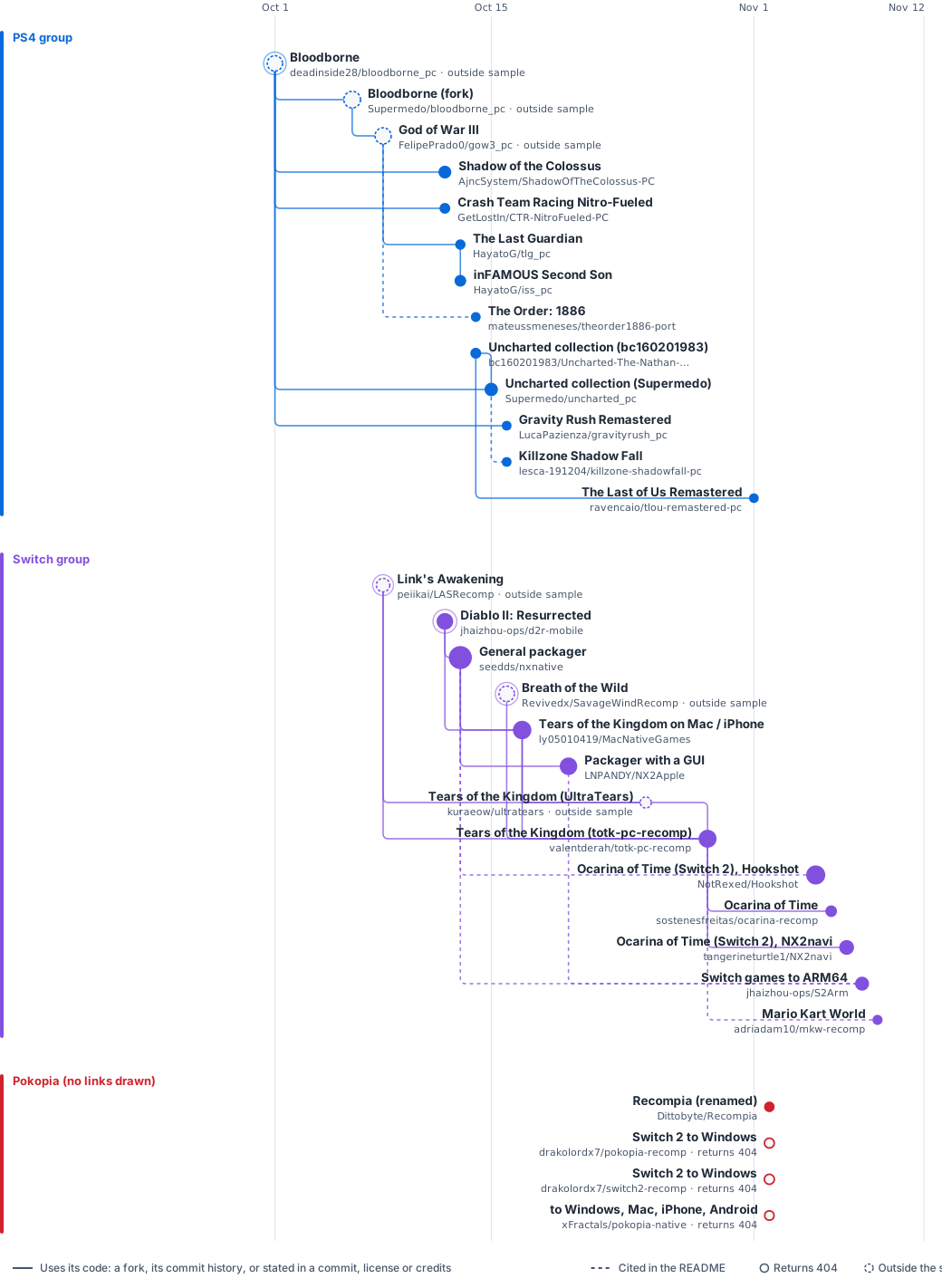
Go through these projects' commit histories, license files and credits one by one, and a lot of them turn out not to start from scratch. Some carry another repository's commit history; others say in a commit message, license or credits section whose code they use. Follow those threads back and two groups take shape, one for PS4 and one for Switch, and a project often has more than one source. 20 projects in the sample connect into these groups: 14 reuse someone else's code (solid lines), 5 only cite or reference another project in their README (dashed lines), and the last, d2r-mobile, is the origin of the Switch group that others build on.
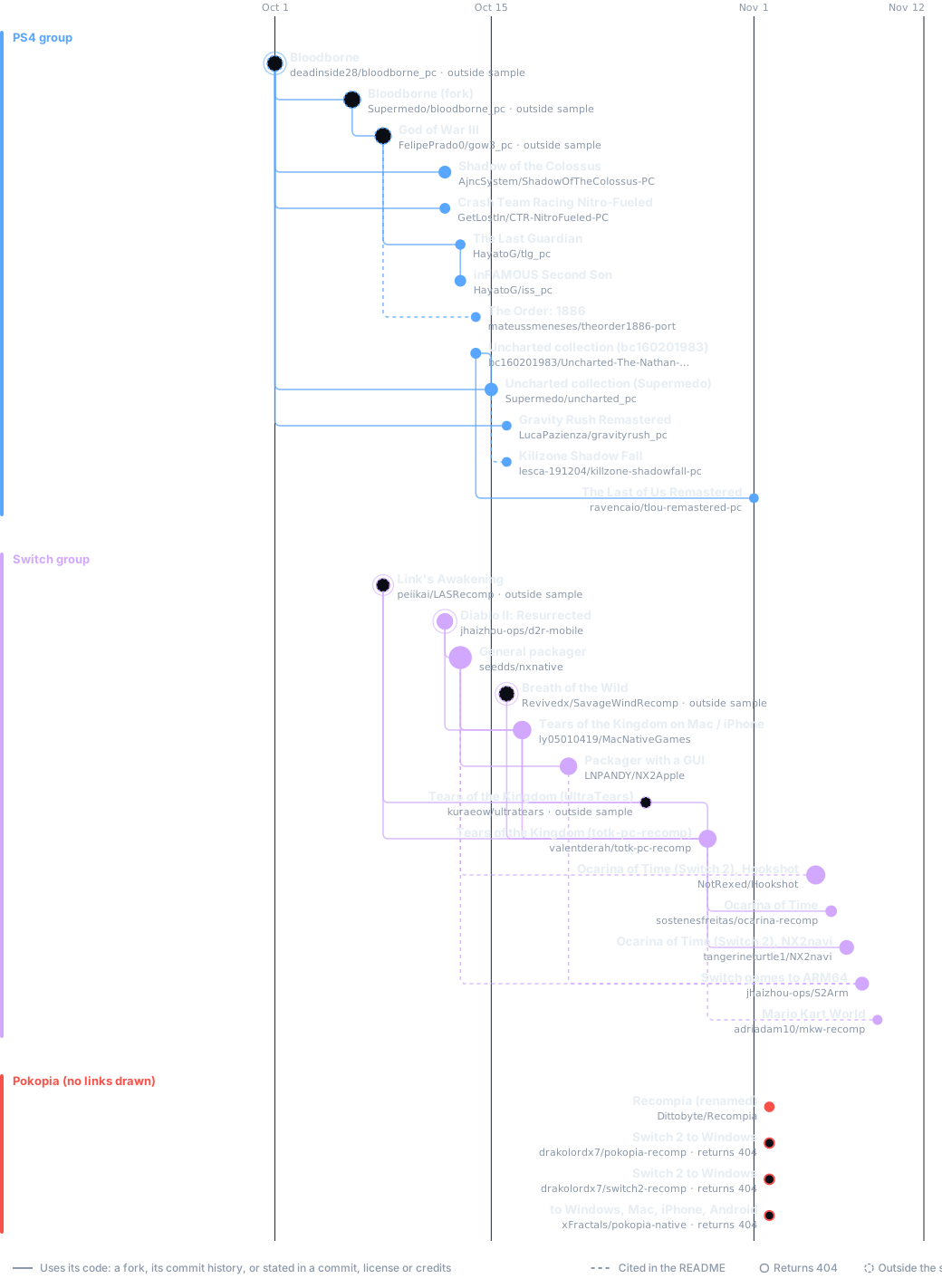
Each row in the chart is a project, placed by the date its repository was created. The six dashed circles are outside the sample: deadinside28/bloodborne_pc, Supermedo/bloodborne_pc, gow3_pc, LASRecomp and SavageWindRecomp are upstreams I found while tracing code back, and UltraTears is the other Tears of the Kingdom port from the same days, built on the same upstreams as totk-pc-recomp.
PS4: it starts with Bloodborne
This group starts with deadinside28/bloodborne_pc, a PC port of Bloodborne with 145 of its 153 commits co-authored by Claude. Between October 12 and 16, ports of Shadow of the Colossus, Crash Team Racing, the Uncharted collection and Gravity Rush set up their repositories one after another, and each of their histories opens with this project's first commit from September 25 (Gravity Rush's copy has a different SHA but identical files). A second branch runs through a God of War III port and on to The Last Guardian and inFAMOUS Second Son.
Switch: it starts with Diablo II and Link's Awakening
The Switch group starts with d2r-mobile, which brought the Switch version of Diablo II: Resurrected to iPhone. It is not actually static recompilation. Switch and iPhone both run on ARM chips, so it only rewrites the few instructions that cannot run under Apple's kernel and runs the rest as is; a compatibility layer handles system services, the graphics API is rebuilt on Metal, and shaders are converted offline ahead of time. The day after it appeared, nxnative set up its repository, and its first commit says its generic parts were taken from d2r-mobile.
MacNativeGames applied the same approach to Tears of the Kingdom, getting it running on Mac and iPhone. Its credits spell it out: the NSO rewriter, the Horizon host and the NVN layer on Metal "all started from its (d2r-mobile's) generic parts". The PC port totk-pc-recomp was then built on MacNativeGames, and its third-party notices list the sources item by item: the system host from MacNativeGames, the code that turns ARM instructions into C from LASRecomp, a static recompilation of Link's Awakening, and the settings menu and performance overlay from SavageWindRecomp, a Breath of the Wild recompilation. Further down, two Ocarina of Time ports carry the totk-pc-recomp author's commits, and the Mario Kart World port points to it in its README.
UltraTears, which put out a beta four days before totk-pc-recomp even created its repository, is best thought of as its sibling. Its first commit (e2f3316) already carries MacNativeGames and LASRecomp code and licenses, almost the same recipe as totk-pc-recomp, with the two starting from MacNativeGames independently. UltraTears later borrowed two things from totk-pc-recomp: FSR1 upscaling shaders added on October 31 (a14ed41) and a mouse camera added on November 11 (3ff96f7), both credited in its third-party notes. 352 of its 359 commits are co-authored by Claude.
Hookshot, another Ocarina of Time port, went its own way. Its credits name code from the Eden and suyu emulators and list nxnative and ocarina-recomp as references, but I found no sign that it descends directly from totk-pc-recomp.
Pokémon Pokopia: four repositories in one day
On November 2, four repositories dedicated to porting Pokémon Pokopia appeared on GitHub on the same day, all aimed at the same new Switch 2 game. I have not verified how they relate, so the chart draws no lines between them. By November 12, only Recompia, renamed once, still opened; the other three return 404. As an aside, MacNativeGames also records a scripted test on Mac that plays Pokopia's opening into the first area (not a full playthrough), and its credits list xFractals/pokopia-native as a reference.
What gets reused
Looking at the games, this wave clusters around two kinds. One is PS4 exclusives that never came to PC: Bloodborne, The Last Guardian, Killzone Shadow Fall and Gravity Rush are all here. The other is games on Nintendo platforms: Tears of the Kingdom, Ocarina of Time, Mario Kart World and Pokémon Pokopia. The components that keep getting reused are just as few. The PS4 group's graphics all start from the shadPS4 emulator, and the Switch group passes down d2r-mobile's system host and graphics layer, LASRecomp's instruction translation and Ryujinx's shader translator, layer by layer.
That is also why the wave moved so fast. Loading the game program, taking over system calls, translating the graphics API: once someone has cracked these hard parts, everyone after them can build on top. NX2navi is a good example. On November 4 the totk-pc-recomp author imported the base code into it (0478c13), and two days later a commit hooked Ocarina of Time up to that host (77d0c0b). How far the game ran at that point, the commit message does not say.
Years of emulator work underneath
First, the difference between an emulator and static recompilation. An emulator pretends to be the console while the game runs, translating the game's instructions and graphics calls on the fly into something the computer can execute; those translations can be cached, and some system interfaces can be swapped for high-level implementations. Static recompilation translates the entire game program into a new computer program before it ever runs, leaving only a layer of code at run time to handle system services and the graphics API. The payoff is a program that runs directly on the computer, which makes widescreen, higher frame rates and mods much easier.
The idea is not new. Work on N64Recomp began in 2022, and Zelda64Recomp, a PC version of Majora's Mask built with it, released 1.0 in May 2024, which is when many players first heard of static recompilation. This wave simply takes the same idea to PS4, Switch and Switch 2. Some projects even skip whole-program translation: Switch and iPhone are both ARM, so projects like d2r-mobile rewrite only a few instructions, run the rest as is on the phone, and leave system services and the graphics API to a compatibility layer.
Among the reuse I could verify, many key parts come from existing emulators and recompilers: the PS4 group's graphics start from shadPS4, and totk-pc-recomp takes its instruction translation from LASRecomp and its shader translation from Ryujinx. The table counts how many project READMEs mention each tool; one project can appear in several rows.
| Tool | What it is | Since | Projects mentioning it |
|---|---|---|---|
| N64Recomp | Static recompiler for N64 games, the precedent for this approach | 2022-11 | precedent |
| Eden / Yuzu / Sudachi | Switch emulators. Yuzu stopped after settling with Nintendo in March 2024; Eden and Sudachi are later forks | 2018 (Yuzu) | 22 |
| Ryujinx | Switch emulator, taken offline in October 2024 after Nintendo reportedly approached its developer; many projects use its graphics translation code | 2018 | 15 |
| shadPS4 | PS4 emulator; the PS4 group's graphics code started from it | 2022-10 | 12 |
| RPCS3 | PS3 emulator | 2012 | 3 |
| rexglue / XenonRecomp | Static recompilers for Xbox 360 | 2024-09 | 3 |
| PS2Recomp | Static recompiler for PS2 | 2025-04 | 2 |
A mention only means the name appears in the README. Some projects use its code, others only say they are not affiliated with it. "Since" is roughly when the project became public (for N64Recomp, shadPS4, XenonRecomp and PS2Recomp, the month its GitHub repository was created); sources can differ by a few months.
What AI did here
Many coding assistants leave a line like Co-Authored-By: … at the end of the commit messages they write, so I counted those. Of the 67 sample projects that still open, 53 have commits with an AI co-author line, all of them including Claude; in 29 projects, more than half of the commits are co-authored by Claude. Some authors say it outright. The totk-pc-recomp README reads "Most of the code and documentation is written by AI coding agents (Claude Code) under the maintainer's direction", and two upstreams outside the sample, LASRecomp and SavageWindRecomp, open their READMEs by saying nearly all of the code, tooling and reverse engineering was done by AI.
These numbers need some care, though. A co-author line only shows that AI took part in a commit; it cannot be turned into a share of the code written by AI. The reverse holds too: no line does not mean no AI, since Cursor and Codex often leave it out by default and merged commits can drop it, so 53 is a lower bound. I also counted only commits made after each repository was created, as a rough way to exclude history inherited from forks. That can miss an author's commits from before the repository existed, or let in upstream commits merged later.
As I see it, AI did not bring any new technique here. The emulator community has been building static recompilers and PS4 and Switch graphics translation for years. What changed is scale and speed (I have no data on hours worked; this comes from the commit logs). 25 of the 67 projects have only one to three commit authors. Take gta-vcs-recomp, luigis-mansion-recompiled and demons-souls-recomp: two or three people each, one to three hundred commits, 88% to 100% of them co-authored by Claude. Add what we saw above, later projects often starting straight from someone else's working code, and I think the picture is clear. Fitting existing parts to one specific game, then fixing it piece by piece until it plays, is the part these authors handed to AI.
Installing is handed to AI too
None of these projects ship the game itself. Players have to bring their own game files, then build, sign and install on their own machine, and for anyone who does not write code that step alone is enough to give up. So a few authors wrote the steps down as instructions for an AI (a Skill) and suggest letting Claude Code or Codex do it. The table shows what each project's documentation says its Skills cover; how far they actually get is up to that documentation.
Hand it to an AI assistant. Open this repository in Claude Code, Codex, or any other AI assistant you like, tell it where your own game file and prod.keys are …
— README of ly05010419/MacNativeGames (the recommended way to install)
| Project | Steps its Skills cover |
|---|---|
| d2r-mobile/d2r-mobile | "Build it with one sentence": check the machine, place the game files, build, sign and install to an iPhone, stopping to ask before anything needing sudo or an Apple account. This is a second repository of the same name: it appeared on Oct 12 alongside the jhaizhou-ops one with a similar README, but the two share no commits and have different authors, and I have not verified how they relate |
| ly05010419/MacNativeGames | Two Skills, install-zelda and install-ra2: where each file goes, which command to run and how long it takes |
| jhaizhou-ops/S2Arm | One player-facing Skill, s2arm-operator: downloading the launcher, importing keys and games, exporting, installing to an iPhone and troubleshooting each step; plus seven developer Skills for graphics, performance and crash diagnosis, and an s2armctl interface in the launcher for the AI to call |
| Jakeschincariol/console-skill | About porting itself: 11 Claude Skills that teach the AI to reverse engineer PS2 game code, rebuild graphics and the backend, and add controller support. Published on Oct 22 |
The first three projects' Skills all revolve around a port that already exists (installing, troubleshooting, developer diagnostics); the reverse engineering is already in the repository. Only console-skill teaches the AI how to port a new game.
Installing used to be a second barrier: developer tools to set up, signing to sort out, files to put in the right place. Now that is handed to the AI, and players only need to say what computer they use and where their game files are. My guess is that as the barrier drops, more people will build, fork, tweak and republish, though I have no usage data to show it yet.
Which repositories no longer open
As of November 12, four repositories in the sample return 404. A 404 only means the repository could not be opened publicly when I checked; it may have been deleted, made private, or renamed without a redirect.
| Project | Game | Status |
|---|---|---|
| drakolordx7/pokopia-recomp | Pokémon Pokopia | created Nov 2, returns 404 |
| drakolordx7/switch2-recomp | Pokémon Pokopia | created Nov 2, returns 404 |
| xFractals/pokopia-native | Pokémon Pokopia | created Nov 2, returns 404 |
| OpenPort-Labs/Galaxy-Android | Super Mario Galaxy (Wii) | created Oct 13, returns 404 |
| BelmanteGu/SuperMarioWonderRecomp (outside the sample) | Super Mario Bros. Wonder | Returns 404; ACNHRecomp says it is based on it |
The public DMCA notices from Nintendo on GitHub since October that I went through:
| Date | Targets | Notice |
|---|---|---|
| Oct 1 | Mirrors of the Ryujinx emulator | 2026-10-01-nintendo.md |
| Oct 1 | nswitch (Yuzu forks) | 2026-10-01-nintendo-3.md |
| Oct 23 | rhythmtengoku: a Rhythm Heaven decompilation, a dozen-plus repositories | 2026-10-23-nintendo.md |
| Nov 6 | Yuzu forks | 2026-11-06-nintendo.md, -3 |
| Nov 6 | The Picofly modchip | 2026-11-06-nintendo-2.md |
| Nov 6 | A large batch of Citron emulator forks | 2026-11-06-nintendo-4.md |
Every one of these notices names emulator forks, a decompilation or a modchip; none names a port from this story's sample. Why the three Pokopia repositories no longer open is not in any public record.
A word of caution. All of these projects require players to dump the game files from their own console, and none ship the game, its art or keys, but that makes them neither legal by default nor safe. In March 2024 Yuzu settled with Nintendo, paying $2.4 million and ending development; that October, Ryujinx reportedly went offline after its lead developer was offered an agreement by Nintendo. This story covers what these projects do and where they came from. It does not explain how to extract or download any game.
Want to play? Which project to use
Below are the ports I could find, grouped by original platform, including some outside the sample that are playable; repositories that no longer open, tools that dump or repackage game files, and projects that rely on exploits or console jailbreaks are left out. The "Progress" column repeats what each project's README says; I have not tested them myself, and "—" means the README does not say. Most of these projects are early and change week to week, so check the project page.
| Game | Original platform | Project | Runs on | Progress (per the project) |
|---|---|---|---|---|
| Bloodborne | PS4 | bloodborne_pc | Windows, Linux | Experimental, playable; a full playthrough not verified |
| God of War III Remastered | PS4 | gow3_pc | Windows; Linux experimental | — |
| Shadow of the Colossus | PS4 | ShadowOfTheColossus-PC | Windows | Finishable start to end |
| Crash Team Racing Nitro-Fueled | PS4 | CTR-NitroFueled-PC | Windows | Playable |
| Uncharted: The Nathan Drake Collection | PS4 | uncharted_pc, another port | Windows | All three games run |
| The Last of Us Remastered | PS4 | tlou-remastered-pc | Windows | Finished by a player; one known crash |
| The Last Guardian | PS4 | tlg_pc | Windows, Linux | Steady 30 fps; 60 fps experimental |
| inFAMOUS Second Son | PS4 | iss_pc | Windows, Linux | First chapters playable; performance unstable |
| Killzone Shadow Fall | PS4 | killzone-shadowfall-pc | Windows | Public beta; campaign playable start to finish |
| Gravity Rush Remastered | PS4 | gravityrush_pc | Windows | Story played through |
| The Order: 1886 | PS4 | theorder1886-port | Windows | Early; reaches a new game |
| DriveClub | PS4 | driveclub-recomp | Windows | Playable, including multiplayer |
| Demon's Souls | PS3 | demons-souls-recomp | Windows; Linux setup script | Whole game playable |
| God of War | PS2 | gow-native-pc | Windows; Linux and Steam Deck experimental | Playable, not finished |
| Grand Theft Auto: Vice City Stories | PS2 | gta-vcs-recomp | Windows, Linux | In development |
| Dante's Inferno | Xbox 360 | hells-gate-recomp | Windows | Playable start to finish |
| Gears of War, three games | Xbox 360 | COGBox | Windows | Playable with a few hiccups |
| Grand Theft Auto V | Xbox 360 | gtav-recomp | Windows, Linux, Mac; can package iPhone and Android builds | — |
| BLACK | Xbox | black-pc, Black-Android | Windows, Linux; Android | PC version fully playable |
| Mortal Kombat: Shaolin Monks | Xbox | OpenShao | Windows, Linux | — |
| Conker: Live & Reloaded | Xbox | Conker-Recomped-and-Reloaded | Windows, Linux | Work in progress |
| Need for Speed: Most Wanted | Xbox | MostWanted-Android | Android | Work in progress |
| The Legend of Zelda: Tears of the Kingdom | Switch | totk-pc-recomp, UltraTears, SkyboundTotk | Windows, Linux; UltraTears also Steam Deck | First two early but playable; SkyboundTotk experimental |
| The Legend of Zelda: Tears of the Kingdom | Switch | MacNativeGames | Mac, iPhone, iPad | Technical exploration |
| The Legend of Zelda: Breath of the Wild | Switch | SavageWindRecomp | Windows, Linux | Alpha; finishable start to end |
| The Legend of Zelda: Breath of the Wild | Wii U | BotW-Native | Windows | Work in progress; reaches the title screen |
| The Legend of Zelda: Link's Awakening | Switch | LASRecomp | Windows, Mac, Linux | — |
| Animal Crossing: New Horizons | Switch | ACNHRecomp | Linux, Mac and others | In development |
| Diablo II: Resurrected | Switch | d2r-mobile | iPhone, iPad, Mac; Android and HarmonyOS via community ports | All 44 devices in the closed beta finished the game |
| Persona 5 Royal | Switch | p5r-android | Android | — |
| The Legend of Zelda: Ocarina of Time | Switch 2 | NX2navi, Hookshot, ocarina-recomp | Windows; Hookshot also Linux | NX2navi early but several areas playable; the other two experimental, mostly tested near the start |
| Mario Kart World | Switch 2 | mkw-recomp; plumber-racer-2 | Windows, Linux; iPhone, Mac | Early; menus and races run; the phone build supports 1.0.0 only |
| Fire Emblem: Fortune's Weave | Switch 2 | fefw-recomp | Windows; Linux and Steam Deck notes | — |
| Pokémon Pokopia | Switch 2 | Recompia | Windows, Linux | Multiplayer supported |
| Super Smash Bros. Brawl | Wii | BrawlRecompiled | Windows, Linux | In development; versus battles work |
| Luigi's Mansion | GameCube | luigis-mansion-recompiled | Windows | — |
| Metroid Prime 2: Echoes | GameCube | MetroidPrime2Port | Windows, Linux, Mac, Android; iOS experimental | — |
| Metroid: Samus Returns | 3DS | msr2ds | Windows, Mac, Linux, Android | — |
| Super Mario All-Stars | SNES | SuperMarioAllStars, SuperMarioAllStarsRecomp | Windows, Android | — |
| The Legend of Zelda: Majora's Mask | N64 | Zelda64Recomp | Windows, Mac, Linux, Steam Deck | Released 1.0 in 2024 |
General tools and emulators not tied to one game:
| Project | What it does | Runs on |
|---|---|---|
| nxnative, NX2Apple, S2Arm | Package your own Switch games as native Mac, iPhone and iPad apps; NX2Apple is the GUI version, with profiles for 147 games | Mac, iPhone, iPad |
| Eglantine, Lichii, Orchid | Switch 2 emulators, all very early; Orchid focuses on a few games such as Mario Tennis Fever | Windows, Linux, Mac |
| Eden-NS2 | Switch 1 emulator | Desktop, mobile |
| AnyPS5 | Converts PS5 game programs into Windows and Linux programs; per-game status in its discussions | Windows, Linux |
| ARMSX3 | Android port of the RPCS3 PS3 emulator; you build it yourself | Android |
| Venture | Runs Meta Quest games you own on a PC VR headset | Windows, Linux |
Whichever project you pick, the steps are much the same. First you need game files dumped from your own console and cartridge or disc; many projects accept only specific versions and regions, and Switch projects usually also need your console's keys. Then download the project's launcher from its releases page, or build it per the README, point it at your game files, and it produces a program you can run; phone builds also need signing and sideloading. Some projects include instructions for an AI to do the installing. I do not cover how to dump game files or keys here; if something goes wrong, start with the known issues in each project's README.
Closing thoughts
Looking back over this month or so, PS4 projects bunched up in mid-October and Switch 2 projects in early November: 11 were created from October 29 to November 4, and 7 more the following week. What interests me is not which game made it to PC next, but that the barrier seems to have come down: several ports have only two or three authors, start from someone else's working code, and have commits largely co-authored by Claude. How much time and effort that actually saves, I do not have the data for yet; it is what I most want to find out next. I will keep an eye on these projects in HotRepo's games topic: who keeps updating, which repositories stop opening, and which platform the next wave starts from.
Appendix: where each line comes from
| Project | Game | Relation | Evidence |
|---|---|---|---|
| deadinside28/bloodborne_pc | Bloodborne | Origin | Created Oct 1; first commit 6849d33 says the graphics started from shadPS4 |
| Supermedo/bloodborne_pc | Bloodborne | Uses deadinside28's code | GitHub fork |
| FelipePrado0/gow3_pc | God of War III | Uses Supermedo/bloodborne_pc's code | GitHub fork |
| AjncSystem/ShadowOfTheColossus-PC | Shadow of the Colossus | Uses deadinside28's code | History contains the same commit 6849d33 |
| GetLostIn/CTR-NitroFueled-PC | Crash Team Racing | Uses deadinside28's code | Same commit 6849d33 |
| Supermedo/uncharted_pc | Uncharted collection | Uses deadinside28's code | Same commit 6849d33; README: "Same idea as my Bloodborne port" |
| LucaPazienza/gravityrush_pc | Gravity Rush | Uses deadinside28's code | First commit 5d04046 has file contents identical to 6849d33 (both git tree 9696960) and the same author and time; only the commit SHA differs |
| HayatoG/tlg_pc | The Last Guardian | Uses gow3_pc's code | Commit 17b008a: "Importa gow3_pc … como base do port" |
| HayatoG/iss_pc | inFAMOUS Second Son | Uses tlg_pc's code | Same author; history starts with The Last Guardian commit 1bd6cd7 |
| mateussmeneses/theorder1886-port | The Order: 1886 | Cites gow3_pc | README link |
| bc160201983/Uncharted…PC-port | Uncharted collection | Uses one component of Supermedo/uncharted_pc | Developed in parallel; its README credits CameraMotion::OnVelocityConstants and the motion vector mode of its temporal anti-aliasing to Supermedo's port (GPL v2). This repository was created a day earlier, so the line points back in time |
| lesca-191204/killzone-shadowfall-pc | Killzone Shadow Fall | Cites Supermedo/uncharted_pc | README link |
| ravencaio/tlou-remastered-pc | The Last of Us Remastered | Uses bc160201983's code | History starts with 6036c2a, the Uncharted collection commit |
| jhaizhou-ops/d2r-mobile | Diablo II | Origin | Created Oct 12 |
| seedds/nxnative | General packager | Uses d2r-mobile's code | Commit d1b1708: "Generic host, gfx and tools taken from d2r-mobile" |
| ly05010419/MacNativeGames | Tears of the Kingdom on Mac / iPhone | Uses d2r-mobile's and nxnative's code | README credits: program rewriter, system host and graphics layer started from d2r-mobile; Switch 2 support carries nxnative code |
| LNPANDY/NX2Apple | Packager with a GUI | Uses nxnative's code | Commit 3543818: "The repository body is nxnative" |
| valentderah/totk-pc-recomp | Tears of the Kingdom on PC | Uses MacNativeGames', LASRecomp's and SavageWindRecomp's code | Listed item by item in THIRD_PARTY_NOTICES.md; docs/architecture.md: "takes the CPU half from LAS Recomp and the game half from MacNativeGames" |
| kuraeow/ultratears | Tears of the Kingdom on PC | Uses MacNativeGames' and LASRecomp's code, later two components of totk-pc-recomp | First commit e2f3316 already carries LICENSE-MacNativeGames and LICENSE-LASRecomp; third_party/README.md credits the FSR1 shaders (a14ed41, Oct 31) and the mouse camera (3ff96f7, Nov 11) to totk-pc-recomp. This repository was created earlier, so the totk-pc-recomp line points back in time |
| sostenesfreitas/ocarina-recomp | Ocarina of Time | Uses totk-pc-recomp's code | History starts with the totk-pc-recomp author's commit 3d73290 |
| tangerineturtle1/NX2navi | Ocarina of Time (Switch 2) | Uses totk-pc-recomp's code | First commit 0478c13, "Import the base tree", is by the totk-pc-recomp author |
| adriadam10/mkw-recomp | Mario Kart World | Cites totk-pc-recomp | README link |
| jhaizhou-ops/S2Arm | Switch games to ARM64 | Cites nxnative and NX2Apple | README links; same account as d2r-mobile |
| NotRexed/Hookshot | Ocarina of Time (Switch 2) | References nxnative and ocarina-recomp | README credits: code from Eden and suyu; nxnative as a shader reference, ocarina-recomp for the README layout |
Data as of November 12, 2026, from HotRepo's board records and GitHub. The sample is the 71 projects created since August that made HotRepo's daily or new-projects board; 68 of them were created between October 5 and November 9.