AI Reverse Engineering Tools: REA and the IDA and Ghidra MCP Servers
To have AI help you reverse engineer, start from what you have: if you use IDA or Ghidra, install their MCP server; with no experience and one feature to understand, try REA (Reverse Engineer Anything); to recreate a website or video, there are separate tools. REA was No. 1 on HotRepo's daily list for 11 days in October, but it ships no decompiler. As I see it, it suits people who don't yet have a method.
Contents
How to choose a reverse engineering tool
It depends on what you need: to understand how a piece of software without source code works, or to have AI build a working copy of a website, video or animation.
Binary reverse engineering
All of these do the same basic thing: let AI call reverse engineering tools. The decompiling and disassembling is still done by IDA, Ghidra and the like, and you should check the conclusions yourself.
| Your situation | What to use | Notes |
|---|---|---|
| You already use IDA Pro | Hex-Rays' official ida-mcp | The most popular community version, ida-pro-mcp (13,591 stars), recommends the official one in its own README. IDA Pro is paid software |
| You use Ghidra (free) | GhidraMCP, or ghidra-mcp with more tools | The first has 12,058 stars and came out earlier; the second says it has 219 tools and is updated more often |
| You prefer the command line | radare2-mcp, or nothing at all | You can also just let your coding agent run the radare2 command line |
| No reverse engineering experience; you want to understand one feature of a program | REA; if it feels too heavy, leanrea | For native binaries, REA needs Ghidra, IDA, Hopper or Kuna installed on your machine |
| Android apps | jadx-ai-mcp; to see only which APIs an app calls, android-reverse-engineering-skill; for large APKs or batch analysis, ASC | ASC says it searches string references 62–302 times faster than JADX |
| Debugging a running Windows program | x64dbg-mcp-server | x64dbg is a free debugger; this plugin gives AI 80 debugging tools |
| iOS apps | Give the app binary to the IDA or Ghidra MCP server above; to write tweaks for an app and debug it on a device, use MonkeyDev, which ships a skill file for AI; REA can take apart the app bundle and crash logs | MonkeyDev has 6,818 stars; it exports headers, restores symbols, and debugs and traces method calls with LLDB. It needs an Apple Silicon Mac, Xcode and an unencrypted app as input. Only analyze apps you have the right to analyze |
| Unity games | Export class and method names with Il2CppDumper first, then hand them to the IDA or Ghidra MCP server; REA can also read IL2CPP metadata directly | Il2CppDumper is not an AI tool, but it generates scripts for IDA and Ghidra. Online games' terms of service usually forbid reverse engineering |
| Firmware for routers, cameras and similar devices | Unpack and scan the firmware with EMBA first, then hand the programs inside to the Ghidra MCP server; REA can also unpack some firmware formats | EMBA is not an AI tool; it is a firmware security analyzer from Siemens |
Web front ends and APIs
To understand how a web page sends requests or how its front end encrypts parameters, use Google's official chrome-devtools-mcp (59,463 stars) to let AI inspect network requests and set logpoints to watch variables (logpoints only log; they don't pause the script); the JS reverse engineering skill in reverse-skill is a ready-made workflow for this. Understanding is fine; calling the APIs in bulk around the website once you have them will likely break its terms of use.
Recreating websites, videos and animations
| What you want to do | What to use | Notes |
|---|---|---|
| Build your own version of a website, app or game | craft-anything | Studies the original, has a coding agent build a new project, then checks it against the original. 43,952 stars |
| Rebuild a video as an editable project | HyperFrames' reverse-any-video skill | Checked against the original frame by frame; skills.sh records 186,700 installs. It is a paid HyperFrames feature and sends HeyGen a usage note when it runs (the skill says you can decline) |
| Just understand how a video was made | rea-video | Judges shot by shot whether it was filmed, AI-generated or coded, and writes up how to remake it. Open source |
| Recreate an animation from a web page | The reanimate skill | Takes apart an animation from a website, video, GIF or Lottie frame by frame, builds it in your code, then checks it |
Copying someone else's website or product runs into copyright more directly than taking a program apart; the "License terms and legal risk" section below is about exactly that.
Stars as of November 26, 2026; skill installs as collected by HotRepo from skills.sh on November 21. Features and figures are as each README states them; I have not tested every tool.
Real-world cases and limits
These are experiences shared by a few Hacker News commenters. Each is a single case, not proof that every program will go the same way:
- Fixing bugs. One person had two bugs in the Windows Remote Desktop client that had bothered him for the better part of a decade. He handed the program file to AI and described the symptoms; it found the spots, patched the program, and both problems went away, with a credible explanation. He had neither Ghidra nor radare2 installed, so the AI wrote its own Python scripts to analyze the file, in a little over half an hour. He published a trimmed transcript.
- Adding features. Another person's 360-camera editing app only supported hardware acceleration on NVIDIA cards and Macs. Running it under Wine on Linux, he had AI reverse engineer the program and wrote a shim to use his laptop's integrated AMD GPU, which he said would have taken him weeks by hand. While at it, he stripped the nag screens, telemetry and social features out of the Android app.
- Understanding an undocumented library. One person only asked AI whether a commercial library could do something; it decompiled the library on its own, found undocumented functions, worked out how they behaved and wrote example code.
- Decompiling an old game. One commenter reviewed an AI-made decompilation of Touhou 4 (Lotus Land Story), done in a month, and called it better than most AI decompilations he had seen: it matches the original build and the variable names make sense.
What it cannot do, or where to be careful:
- Fixed is not the same as fixed correctly. The Remote Desktop patch simply skipped the call that got the window size wrong. Someone pointed out that this avoids the problem and may not be free of side effects for every use.
- Large files are slow. A few-hundred-MB APK takes tens of minutes to preprocess in JADX; packed, obfuscated or virtualized programs are hard work for AI too.
- Structured for AI. The commenter who reviewed the game decompilation also said its files are organized for AI's convenience rather than the original developers' intent.
- Models may refuse. Mainstream models sometimes refuse reverse engineering tasks, especially requests to find vulnerabilities or break licensing.
A free way to start
A route that costs nothing. Practice on programs you wrote or have the right to analyze, and analyze programs of unknown origin in a virtual machine (more in the "Safety" section below):
- Install Ghidra, the NSA's open-source reverse engineering tool (install the JDK version it requires first).
- Download the plugin matching your Ghidra version from GhidraMCP's releases, install it in Ghidra with File → Install Extensions, and restart.
- Under File → Configure → Developer, make sure GhidraMCPPlugin is enabled; skip this and your agent won't be able to connect.
- Follow GhidraMCP's README to add it to the coding agent you use. If you don't want the Ghidra window, its headless mode can analyze a program you name directly.
If you already have IDA Pro, replace steps 1–3 with Hex-Rays' official ida-mcp. If you want to install nothing at all, you can first just hand the program to your coding agent, as in the Remote Desktop example, and add the tools above when it meets a program too big to handle on its own.
What REA provides
REA (Reverse Engineer Anything) ships no decompiler of its own. According to its README and list of supported targets, it does three things:
- One entry point. One command installs it into your coding agent (MCP); it also works directly in the terminal.
- Built-in format parsing. The structure of Windows and Linux programs, APK signatures, .NET assemblies, Unity and Godot game resources, PyInstaller-packed programs and dozens more, with no extra tools. Network captures and firmware are only partly built in: captures need tshark, and some firmware needs Binwalk or Unblob.
- Calls to tools you have installed. Native binaries need Hopper, Ghidra, IDA or Kuna; Android apps need JADX; it can also use JEB, Frida and others. It packages the results as "code, references, and what is still unknown" for the AI.
What separates it from asking AI to install Ghidra yourself is this ready-made workflow and the organized output. In the 340-comment Hacker News thread, views fell into a few groups:
- Several commenters questioned what it adds, asking how this beats letting AI install Ghidra or handing it radare2; the person who fixed the Remote Desktop bugs above also felt top models do well without extra tools.
- Others found it useful. One commenter running a small local model said it got completely lost using the Ghidra command line on its own, and started making progress with REA.
- Android analysis is slow. ASC's author said in the thread that REA relies on JADX for Android, which spends tens of minutes preprocessing an APK of a few hundred MB and cannot handle batch analysis, so he wrote ASC.
- It is heavy. leanrea's README compares the two: REA 6.5.0 installs as a 25 MB npm package and adds 207 tools to the agent, with 3.35 MB of tool definitions. In a setup that loads all tool definitions, just asking the AI to reply "OK" used about 400,000 tokens with REA and about 34,500 with leanrea. leanrea replaces it with one 8 KB skill file and has the AI use command-line tools directly.
The three approaches side by side:
| What you install | Tools added to the AI | What else you need | |
|---|---|---|---|
| REA | An npm package plus an MCP server (about 25 MB in version 6.5.0) | 207 | Ghidra, IDA, Hopper or Kuna for native binaries; JADX for Android |
| leanrea | One 8 KB skill file | 0; the AI uses the command line | Whichever command-line tools it needs |
| Ghidra or IDA MCP server | A plugin plus an MCP server | Depends on the project; ghidra-mcp says 219 | Ghidra or IDA itself |
The REA and leanrea figures come from leanrea's README and compare REA 6.5.0; the context usage was measured in Claude Code with all tool definitions loaded. REA is now at 6.10.
How REA took off
REA's repository was created on April 14, 2026, its first release came out in July, and a Show HN post got 3 points. On October 6 it first appeared on HotRepo's all-languages daily list, at No. 1, and stayed at No. 1 for 11 days in a row, going from 7,569 to 281,556 stars. The big Hacker News thread (814 points, 340 comments) came on October 10, when it had already been on top for four days.
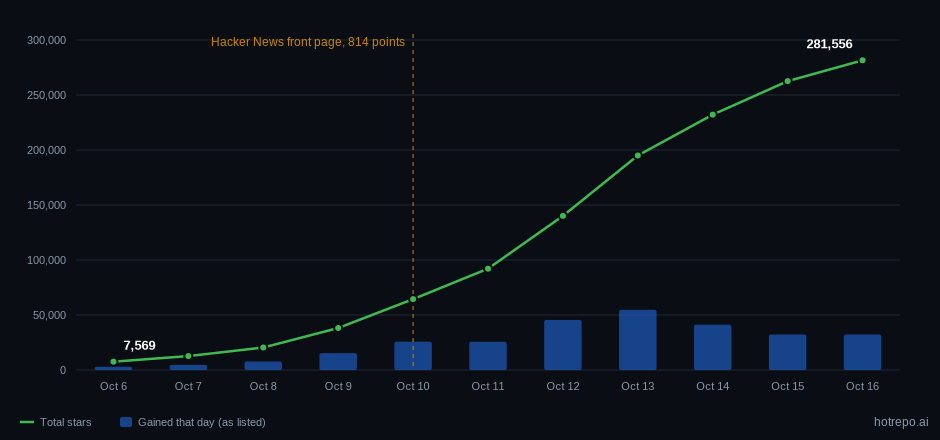
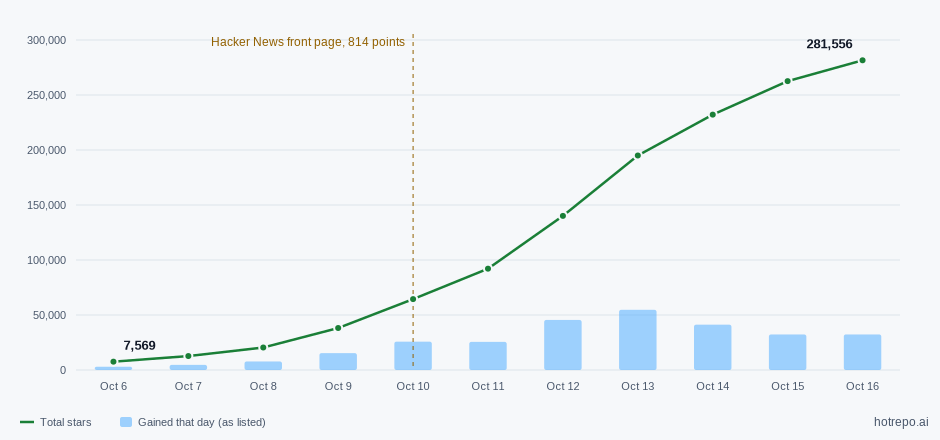
From HotRepo's all-languages daily list snapshots. This stretch is imported historical data with one record per day: points on the line are the star count recorded that day, and bars are the stars gained that day as recorded by the list, not the difference between neighboring points.
On November 26 the repository had 479,316 stars. The rea-agents npm package was downloaded 603,138 times from November 1 to 10 and 519,952 times from November 11 to 20. It was not the first, either: reverse-skill, created in May, reached No. 1 on the daily list in early August. After REA came the prompt collection REA-Prompts, rea-video for videos, craft-anything for cloning and rea-games for rebuilding games. REA's developer told Scientific American that his interest in reverse engineering began with game decompilation; this year's wave of console game ports is reverse engineering too, covered in two other stories, console game PC ports and GTA 6.
Common reverse engineering skills
Sorted by the install counts skills.sh records:
| Skill | What it does | Installs |
|---|---|---|
| REA | REA's own skill, teaching AI to use it on programs, apps, firmware and web targets | 20,200 |
| Protocol reverse engineering | Analyzes network traffic to take apart and document undocumented protocols | 13,900 |
| Binary analysis | Understands compiled programs through disassembly, decompilation and control-flow analysis | 11,700 |
| Anti-reversing techniques | Explains the anti-debugging and obfuscation you meet in packed or protected programs | 11,600 |
| leanrea | One skill file that has AI do what REA does with local command-line tools | 3,400 |
| reverse-skill's reverse engineering entry | Works out how a packed, obfuscated or virtualized program operates | 2,200 |
| reverse-skill's JS reverse engineering | Traces front-end JavaScript signing logic and reproduces it locally | 1,500 |
Installs as collected by HotRepo from skills.sh: November 26, 2026 for the two reverse-skill entries, November 21 for the rest; skills.sh counts installs, not use. reverse-skill has 89 skills in all, many of them offensive (evading antivirus, writing exploits); check what each skill does before using it.
If you are starting from zero and want to learn the methods first, begin with awesome-reverse-engineering, a learning list put together by REA's own developer, alongside the binary analysis and anti-reversing skills above, or an introductory skill that teaches a reverse engineering course.
Safety
- Practice on programs you wrote or have the right to analyze.
- Analyze programs of unknown origin in a virtual machine. Dynamic analysis actually runs them; REA's documentation also says its runtime capture runs or interacts with the target using your user permissions.
- Check what an installer will change before approving it. REA is now installed by running
npx rea-agents setup, choosing your agent and approving the setup plan it shows; it backs up the agent's existing configuration before adding REA's connection and skill. The README suggests running it outside the project you plan to analyze.
License terms and legal risk
Reverse engineering is not illegal in itself, but many software licenses explicitly forbid it. REA's README also states what it is for: lawful research, education, interoperability, software preservation, and analysis of software you own or are authorized to examine.
The Scientific American article quotes James Grimmelmann, a law professor at Cornell Tech: "This is going to pose a crisis for trade secret and copyright law." His point is that copyright protects the code itself, not the algorithms and ideas the code implements; once AI can pull the ideas out of someone else's software and write them again, that line gets hard to hold. 404 Media worries about the other side: small companies whose products are taken apart and cloned by competitors using AI. As the bar drops, the uses get messier: in the same period, HotRepo's lists also showed projects that use reverse engineering tools to unlock hidden trials of paid services.
Final thoughts
The Remote Desktop example shows that, at least on some tasks, a model can now pick its own tools, write its own scripts and finish the analysis. It is one case; a larger, better-protected program may not go so well. As I see it, what the tools add here is a connection to existing analysis tools like IDA and Ghidra, plus a method, and the stronger the model, the less that wrapper matters.
So choose by what you already have. If you use IDA or Ghidra, install the matching MCP server and let AI drive the tools you know. If you have no experience, start with REA or the lighter leanrea, knowing they wrap existing tools. If you want to recreate a website or video with craft-anything, reverse-any-video and the like, first make sure you have the right to.
Data as of November 26, 2026: lists from HotRepo's all-languages daily and new-projects list snapshots; stars from GitHub; downloads from npm; skill installs from skills.sh; Hacker News data from hn.algolia.com.