Hacked by Opening a Web Page? A Look at Coruna, DarkSword and worse_query on the iPhone
Coruna and DarkSword, exposed in 2026, are attack chains that take over an iPhone from a single web page, while worse_query lets a sideloaded app read and write other apps' data. In my view, the most effective protection for ordinary users is installing official security updates promptly, and that only matters more now that AI has entered vulnerability research.
Contents
A warning from Binance
On November 8, 2026, a developer who goes by forcequit published worse_query on GitHub, described in one line: a sandbox escape for iOS 26 and 27. On November 10, Binance publicly warned iPhone users that, through this bug, a malicious app could read other apps' data, exposing wallet seed phrases and private keys; the affected versions it named were iOS 26.7.1, 27.0.1 and 27.2 (BleepingComputer). Apple had shipped iOS 26.7.3 and 27.2.1 the day before, and their security notes did not mention it.
It was not the first time this year. In March, Google Threat Intelligence Group (GTIG) disclosed two attack kits aimed at iPhones: Coruna and DarkSword. All of these tend to get lumped together as "iOS exploits", but what they can do, what they need and who used them differ a lot. This article separates three things: when they appeared and which systems they hit; what each can do and roughly how it works; and how ordinary users can protect themselves.
Which iOS versions are affected
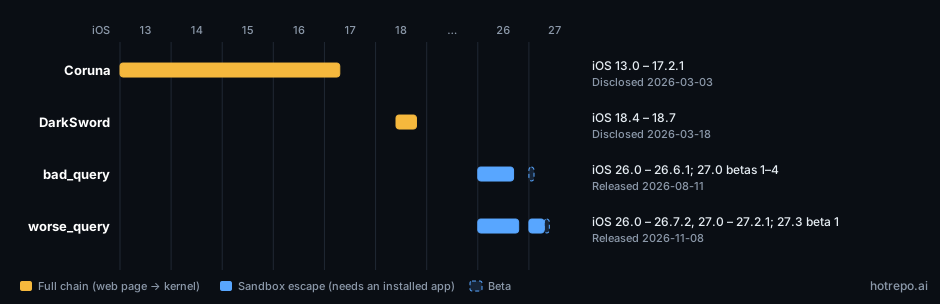
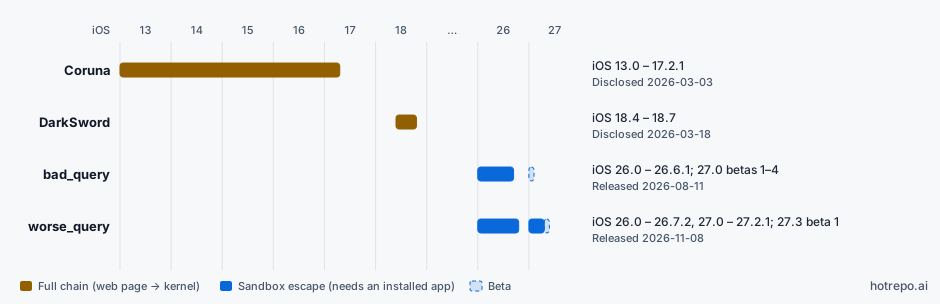
Bars are the iOS version ranges each one targets, labelled with the exact first and last versions; dashed boxes are betas; the date on the right is when it went public. Sources: GTIG, Lookout and iVerify reports, and each project's README.
A common question first: did attackers break each new iOS release as soon as it came out? Not with Coruna and DarkSword; worse_query is a different story.
Coruna targets iOS 13.0 through 17.2.1, systems released between September 2019 and December 2023. GTIG first captured parts of it in February 2025 and published the full report on March 3, 2026. By then the latest system was iOS 26, so even the newest version Coruna could attack was more than two years old. Most of the bugs behind its 23 exploits were fixed soon after the versions they targeted; the WebKit bug used by its last entry point was fixed in iOS 17.3 (January 2024), so 17.3 and later are not affected.
DarkSword targets iOS 18.4 through 18.7. GTIG saw it in use since at least November 2025, two months after iOS 26 came out. It uses six bugs, three of which were exploited as 0days, meaning they were used in attacks before Apple shipped a patch. All six were fixed as of iOS 26.3, and devices still on iOS 18 block its entry point by updating to 18.7.3. Less than a week after the March 18 report, on March 23, TechCrunch reported that a newer version had been posted anonymously to GitHub.
bad_query and worse_query are different. bad_query came out on August 11, 2026, covering iOS 26.0 to 26.6.1 and the iOS 27 beta of the time, and stopped working from 26.7. Three months later worse_query, billed as its successor, listed iOS 26.0 to 26.7.2 and 27.2 in its README; tools built on it report that it works on 27.0 through 27.2.1 and on 27.3 beta 1. From iOS 27.3 beta 2 (build 24C5049d), those tools all state in their READMEs that it no longer works. But as of November 21, Apple's latest public release was still 27.2.1, Apple had not announced a fix, and the author of WQFiles confirmed it working on 27.2.1. In other words, a fix in a public release has to wait for 27.3.
So there are two situations. When Coruna and DarkSword went public, updates that blocked them were already out; worse_query went public with no patch, and the current public release was still affected at the time of writing.
Full attack chains vs. sandbox escapes
Every app on an iPhone, and every web page in Safari, runs in its own sandbox: it can touch its own files, cannot see other apps' data, and cannot change the system. To take over a whole phone, an attacker has to break through these walls one by one.
Coruna and DarkSword are full attack chains, running from a web page all the way to the core of the system. Taking DarkSword as GTIG broke it down, the steps are roughly:
- The user opens a tampered page in Safari (a hacked legitimate site or a fake one). A hidden frame on the page checks the device model and iOS version, then decides whether to attack;
- A memory bug in the browser's JavaScript engine lets it run its own code in the web page's process, while bypassing pointer authentication (PAC, a hardware protection against code tampering on Apple chips);
- Bugs in the graphics component (WebGL) and in kernel memory management let it jump into the GPU process and then into a system service, escaping two sandboxes;
- A final kernel bug gives it kernel-level read and write access, which effectively means control of the whole phone.
All the user has to do is open a web page. Coruna follows the same idea at a larger scale: it carries 5 complete chains and 23 exploits and picks the set that matches your iOS version.
What happens next depends on who is using it. The data GTIG lists for DarkSword's data-stealing module includes the iMessage database, Telegram and WhatsApp data, mail indexes, call logs, contacts, keychains, location history, Wi-Fi passwords, photo metadata and hidden photos, screenshots, iCloud Drive files, Notes, Safari history and crypto wallet data; security researchers who analysed samples found it sends the data out within seconds to minutes, then cleans up and exits. Once Coruna reached a financially motivated group, it was mainly used to steal crypto: scanning Notes and images for seed phrases and hooking about 19 wallet apps. Its users included a suspected Russia-linked espionage group (the same group used both kits), a Turkish commercial surveillance vendor, and a financially motivated group operating from China that ran fake exchange sites.
worse_query is only a sandbox escape, with far less power and more conditions:
- An app has to be installed on your phone first, and it needs an App Group (a setting that lets apps from the same developer share data). The public tools are all sideloaded with the user's own Apple ID, outside the App Store;
- Once installed, that app can read and write other apps' data containers and App Group shared folders, and on iOS 27 some system folders too;
- It does not get kernel access. The author states in the README that it "is not relevant to a jailbreak and never will be."
The README does not explain how it works, only which folders it can reach. That is exactly Binance's concern: hidden inside an app that looks harmless, it could read the seed phrases a wallet app stores. At the time of writing, neither Binance nor the author had reported real attacks using worse_query, and there is no public evidence that an App Store app has used it. So for now the most direct protection against it is installing apps only from sources you trust.
Related open-source projects
After each disclosure, a batch of related repositories appeared on GitHub. By purpose they fall roughly into four groups:
| Kind | Examples | What they do |
|---|---|---|
| Analysis write-ups | Rat5ak/CORUNA_TECHNICAL_ANALYSIS and others | Explain the structure of the chains in prose |
| Proofs of concept | bad_query, worse_query | Show that the bug exists; the author says they are "for developers" and not useful by themselves |
| Tools built on the bugs | Erosion, Erosion-CN, WQFiles, lara | Change wallpapers, dialer themes and system settings, or manage other apps' files |
| Protection | AntiDarkSword | For already-jailbroken older devices: turns off JIT and blocks remote content to make these chains less likely to land |
The third group gets the most attention. Erosion started on bad_query and later switched to worse_query to build a customization toolbox. Its Chinese derivative Erosion-CN, created on November 10, passed 2,600 stars in under two weeks; its description is about enabling features such as Apple Intelligence and eSIM on mainland China devices, and it is also the most visited project of this group on HotRepo. WQFiles is a file manager that can browse, back up and clear any app's data. After the DarkSword leak, its kernel part was also rewritten and turned into lara, a toolbox for iOS 17 through 18.7.1.
Two more groups I am not listing: code that reproduces individual bugs, and repositories that repackage the leaked chains as-is, some even modified so anyone can host them. Most carry a "research only" disclaimer, but they are of no use to ordinary readers and the risk is real.
AI is speeding up vulnerability discovery
One more thing changed this year: AI is now genuinely being used to find bugs and write exploits.
In April, Anthropic announced an internal model, Claude Mythos Preview, which it said can, when directed, find 0days in every major operating system and major browser and build working exploits, and which it used to find thousands of previously unknown vulnerabilities. The model is not public; it is available only to Project Glasswing partners to fix their own systems (Anthropic).
The cases in this article show traces of AI as well. GTIG found that some comments in Coruna's code looked LLM-generated; one researcher who took Coruna apart said plainly in a README that the deobfuscation was "heavily based on AI"; and of the latest 100 commits to WQFiles, which is built on worse_query, 88 are co-signed by Claude.
These show what AI can do and where researchers have put it to use, but they cannot tell us how much faster these iOS cases moved because of it. In my view, the direction is clear: finding bugs, understanding other people's exploit code and turning bugs into tools are all getting easier. For ordinary users, that makes the first recommendation in the next section matter more.
How we can protect ourselves
First, install official security updates promptly. This is the most effective step, and the first recommendation from GTIG, Lookout, iVerify and Binance alike. Coruna does not work on iOS 17.3 or later, and every bug DarkSword uses was fixed as of iOS 26.3; when both kits went public, updates that blocked them were already available. worse_query no longer works in the 27.3 beta; install 27.3 as soon as the public release arrives. Turn on Automatic Updates in Settings.
I have noticed some customization tools giving the opposite advice: stay on an older version and turn off automatic updates to keep the features working. For developers and enthusiasts who understand the risk, that is a personal choice. For ordinary users, a wallpaper or a regional feature is not worth leaving the whole phone on a version with a public exploit: once a bug is public, the bar for using it drops a lot.
Second, install apps only from sources you trust. A sandbox escape like worse_query only works once an app is on your phone. Installers and profiles from file-sharing links, group chats or unfamiliar sites, and tools promising to "unlock" a feature for free, deserve a hard look at where they came from. The App Store is not a guarantee either: according to CryptoSlate, in September SlowMist found a kernel exploitation module hidden in FomoPeek, a crypto tracker listed on the App Store, and the blockchain security firm Salus estimated it stole about 580,000 USDT. Apps with an unclear origin, few reviews, or permissions that do not match what they do deserve extra caution even in the store.
Third, if you might be personally targeted, consider Lockdown Mode. Apple positions Lockdown Mode as extra protection for the very few people who, because of who they are or what they do, might be targeted by highly sophisticated attacks; it is available from iOS 16. It turns off some complex web features and blocks most message attachments, which sits right in front of these chains' entry points: in GTIG's analysis, Coruna gives up when it detects Lockdown Mode or private browsing, and GTIG also recommends it for devices that cannot be updated for now. The cost is that many websites and features become less convenient. It is under Settings → Privacy & Security → Lockdown Mode.
Fourth, beware of fake jailbreaks and copycat sites. Every time an exploit makes the news, paid "jailbreak" sites appear. The researcher opa334 warns in his own repository that fake jailbreaks on domains like pangu8 keep scamming users out of money. Real jailbreak tools are almost always free and never ask you to pay first or install a profile.
Fifth, take extra care if you hold crypto. Coruna, DarkSword and FomoPeek all went after wallets. Do not photograph your seed phrase or keep it in Notes. If you suspect your phone was compromised, Binance's advice is to create a new wallet on a clean device, move your funds there, and log out of all active sessions.
Final thoughts
Put these cases side by side and there are roughly two ways an iPhone gets compromised: a vulnerable system gets taken over from a web page, or an app that should not be there is installed. The first is solved by updating, the second by habit. When Coruna and DarkSword went public, the patches already existed; the remaining gap was whether devices had installed them.
In my view, "the iPhone is secure" needs two conditions attached: the system is up to date, and the apps come from sources you trust. worse_query went public before any patch, which shows you need both. With AI now in vulnerability research, the thing that shortens your exposure is still tapping "Install Now" as soon as an update appears.
Data as of November 21, 2026. Chain details, version ranges and data categories come from public reports by Google Threat Intelligence Group (Coruna, DarkSword), Lookout and iVerify; DarkSword's exfiltration speed is from The Hacker News; the DarkSword leak is from TechCrunch; who Lockdown Mode is for is from Apple; version support for each project follows its GitHub README. This article does not provide any exploit details or operating instructions.